۞ भगवान् को छोड कर और कहीं दिल लगाया तो अंत में पछताना पडेगा ! ۞

Showing posts with label Earth Day. Show all posts

Saturday, September 17, 2011

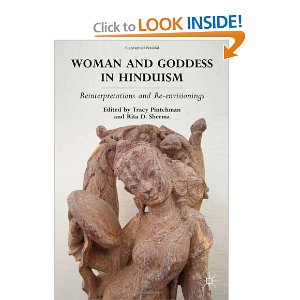
Woman and Goddess in Hinduism: Reinterpretations and Re-envisionings


Review

 "The role of the female within the Hindu tradition is both varied and vigorous, as the multiple contributors to this text reveal. They bring together scholarship and sensitivity in conveying unique dimensions and valuable perceptions of that role. This book is an important read for anyone seeking to comprehend female spirituality and divinity in the Hindu context." --Ramdas Lamb, Associate Professor of Religion, University of Hawaii at Manoa
 
"The essays in this outstanding volume successfully avoid the common pitfalls of, on the one hand, objectifying and exoticizing the various Hindu categories and concepts with which they engage, and on the other, of deploying these same categories and concepts in a simplistic and uncritical manner. The hermeneutics of intersubjectivity that the authors skillfully apply to their materials should be a model for future work in the field of Hindu studies." --Jeffery D. Long, Associate Professor of Religion and Asian Studies, Elizabethtown College, and author of A Vision for Hinduism: Beyond Hindu Nationalism and Jainism: An Introduction
 
"This book skillfully addresses all things feminine in Indian traditions: goddesses, female gurus, the lives of Hindu women, and more. Includes many excellent new translations of key passages from Sanskrit litereature." --Christopher Key Chapple, Doshi Professor of Indic and Comparative Theology, Loyola Marymount University

Product Description

Offering multilayered explorations of Hindu understandings of the Feminine, both human and divine, this book emphasizes theological and activist methods and aims over historical, anthropological, and literary ones. The contributors approach the Feminine in Hindu traditions from the standpoint of intersubjective construction via a method that can be termed dialexis. Here, dialexis refers to a form of intellectual engagement “across styles” that takes as its starting point an adequate accounting of contextualized signification. The diverse ways that cultures articulate themselves are rooted in lexical choices made in historical, geographical, and cultural contexts. 


Vastu: Transcendental Home Design in Harmony with Nature


Review

This book is delightfully illustrated. Its clearly detailed information explains time honored ways that will nourish our lives. We discover the importance of incorporating the five elements and directions into our architecture to truly establish sanctuary. How important is it for you to enhance your relationships, your inner peace and your joy? If that is a desire in your life `vastu' is a powerful method for your transition. This book, then, is a must have! -- Mystic Pop Magazine

Product Description

The notion of designing and respecting sacred space has been around for centuries, recognized in such current culture trends as Feng Shui, Wabi Sabi, and even the push to make homes greener. Vastu-India's ancient science of architecture and design for buildings and gardens-is the origin of traditions like Feng Shui, and finally gets a proper introduction in Vastu: Transcendental Home Design In Harmony with Nature ($29.95; Hardcover; Gibbs Smith, Publisher, October 2007) by Vastu sacred space design consultant Sherri Silverman.

Vastu is a beautifully illustrated and detailed guide to harnessing the tremendous power of this ancient tradition to create tranquil, attractive living spaces that bring the home-and everyone in it-back to center by enhancing inner peace, joy, prosperity, and relationships through attention to the structure and design of living and work areas. Vastu actually enables one to not just leave a light footprint on the earth, but to also improve the environment while living in a home that supports, nourishes, and protects health, happiness, and fulfillment.

Vastu covers all rooms in the home, as well as directions (north, south, east, west, northeast, northwest, southeast, southwest, center), the five elements (earth, water, fire, air, and space), the importance of beauty and natural materials, clearing of clutter, and air quality. Vastu also provides tips that teach how to use the power of meditation, love, grace and gratitude, sacred archetypal energies, mantras, and yantras to bless a house, and much more.

With five sections explaining the fundamentals of this ancient Vedic system, Vastu clearly and simply tells homeowners and apartment dwellers how to apply its principles to create a truly tranquil home, whether building new, or improving an existing space. Learn what Vastu is, and how it creates home as sanctuary. Discover the detailed components one should consider when creating a Vastu home to gain greater support for relationships, health, finance, and career. Walk through the house and yard for tips on the arrangement and décor of each area, and discover related, complementary techniques that can be applied to bless and energize the house. Finally, Vastu offers resources for further study, a detailed glossary, bibliography, and index.

Sherri Silverman, PhD has taught meditation, yoga, breathing techniques, and sacred text courses from the Vedic tradition since 1974. She holds a PhD in Creativity, the Arts, and the Sacred Application of Asian Concepts. Through her firm, Transcendence Design, she works with clients nationally and internationally, sharing the principles of Vastu for home, businesses, and community buildings. She lives in Santa Fe.

Vedic Astrology Simply Put: An Illustrated Guide to the Astrology of Ancient India


Product Description

Vedic Astrology Simply Put is a colorful, fun, and simplified entry into the mysterious and captivating world of Vedic Astrology, called Jyotish in India. William R. Levacy, an astrologer with more than two decades of experience, offers beautifully rendered illustrations and text to ease your understanding of this ancient system of behavior and trend analysis. This book gives you straightforward guidance on:
•       How to decipher the myths and origins of Vedic astrology
•       How Vedic astrology differs from Western or Tropical astrology
•       The Vedic style of interpreting the Sun, Moon, planets, houses, and signs
•       How the Vedic seers used the Moon signs (called nakshatras) and other special techniques to  zero in on how people behave
•       How to use Ayurveda, the Science of Health; and Vastu—the Science of Space (India’s counterpart to Feng Shui)—integrated with Vedic astrology, the Science of Time
Much of the Vedic art was custom created for this book by master artists in India. There’s also a special bonus enclosed—a free CD-Rom of the popular “Parashara’s Light SE” Vedic astrology software.

About the Author

William R. Levacy holds a B.A. in literature and an M.A. in Education. He has been a practitioner of Vedic astrology or Jyotish, as it is called in India, since 1983. Bill also received a master’s degree in the Science of Creative Intelligence in 1977 from Maharishi European Research University, where he concentrated his studies on Vedic science. In 1996, Levacy was one of a very few Westerners to ever receive the prestigious Jyotish Kovid award from the Bangalore Chapter of the Indian Council of Astrological Sciences (ICAS). His two decades of experience as a business consultant in the aerospace industry contributes to the practical, yet personal nature of his readings; and is reflected in his practical work on Vedic astrology, Beneath a Vedic Sky